
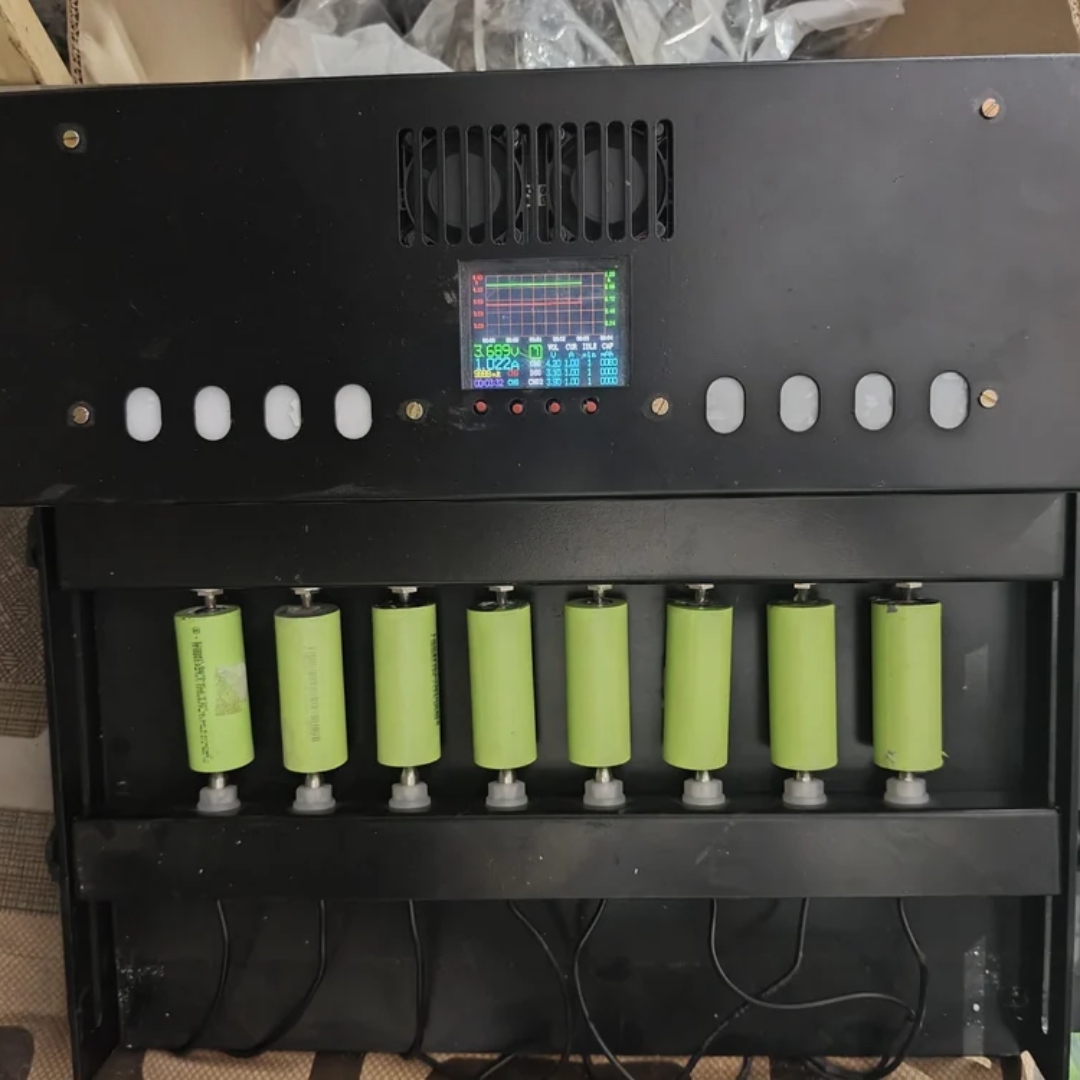
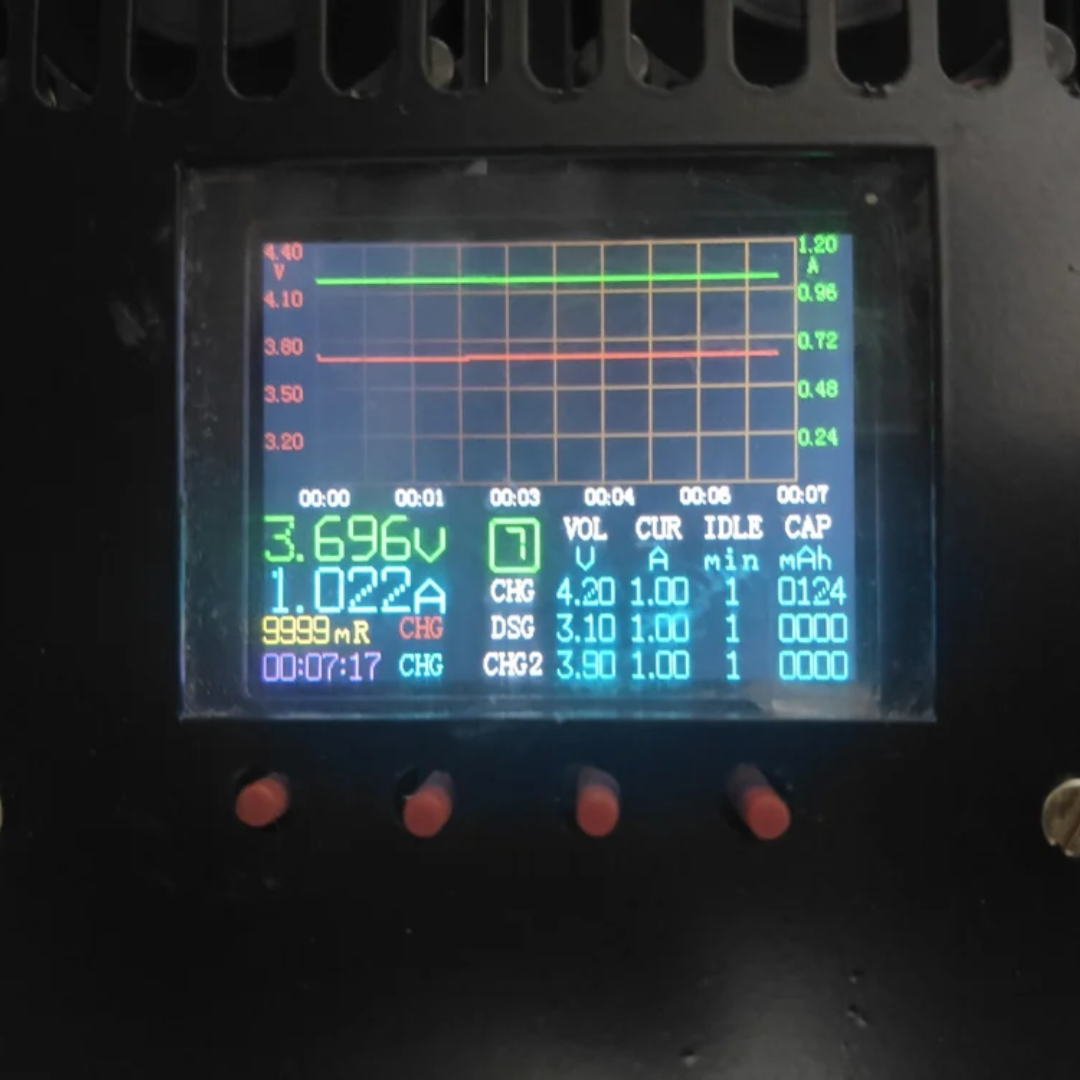
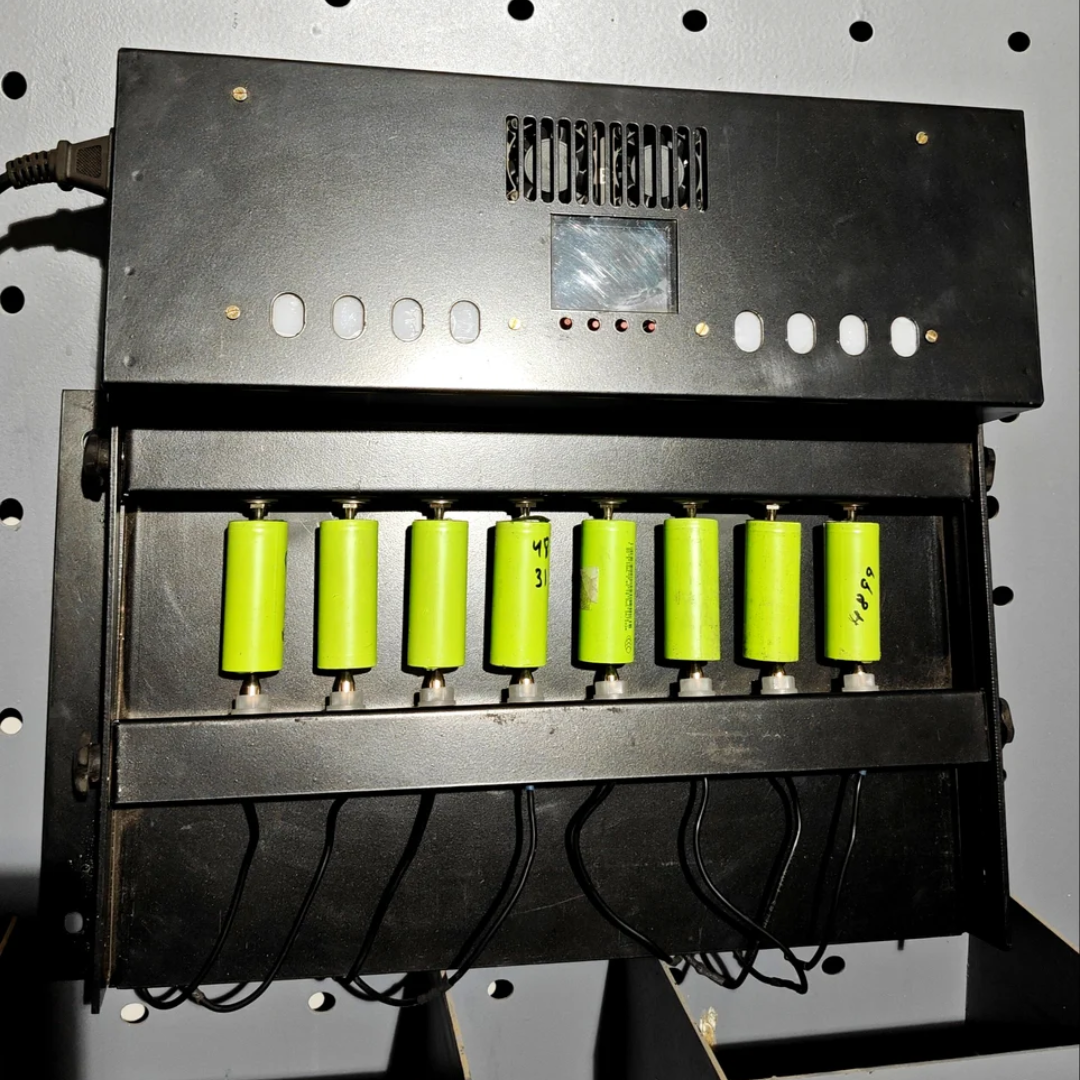
Lithium Ion Cell Capacity Testing Machine
₹13,000.00

| Cell chemistry | LiFePO4, Lithium ion |
| Cell voltage range | 0 to 5 V |
| Test current max | 1amp |
| Measurement | Voltage |
| Channel count | 8 channel |
| Interface | Manually |
| Display type | LCD |
| Data logging | Onboard memory |
| Power supply | Battery power |
| 18650/26650/32700/32140/33140 all type nmc and lfp cell charging and discharging machine | 2.5 v lowest voltage to higher 4.2v manually adjust |
Lithium Ion Cell Capacity Testing Machine
1. Accurate
Lithium Ion Cell Capacity Testing Machine
measurement is an essential part of lithium-ion cell testing Machine The JOYEVKART testing solution is designed to help users measure Lithium Ion cell capacity testing machine during controlled discharge testing. This information helps battery manufacturers and assemblers evaluate whether cells meet their required capacity specifications. 2. Charging and Discharging Testing Charging and discharging tests help users understand how a lithium-ion battery cell performs during different operating stages. A Lithium Ion Cell Capacity Testing Machine supports this important testing process by allowing battery cells to undergo controlled charging and discharging cycles according to configured parameters. 3. Voltage Monitoring Voltage monitoring helps users observe the electrical behaviour of lithium-ion battery cells during testing. It provides useful information about cell voltage throughout the charging and discharging process and helps identify cells that do not perform as expected.
4. Current Monitoring Current monitoring is another important part of battery testing. It allows users to evaluate the charging and discharging current applied to battery cells. Proper current control helps maintain consistent testing conditions. 5. Battery Performance Analysis The testing process provides useful information about battery cell performance. Users can analyse capacity, voltage, and charging and discharging behaviour to support battery quality evaluation and selection. 6. Support for Battery Quality Inspection A Lithium Ion Cell Capacity Testing Machine can be incorporated into battery manufacturing and assembly workflows to help inspect cells before they are used in battery packs. This can help businesses identify cells that do not meet their defined performance requirements. Applications of Lithium Ion Cell Capacity Testing Machine The Lithium Ion Cell Capacity Testing Machine can be used in different industries and professional environments where lithium-ion battery testing is required.
1. Multiple battery test modes
This battery capacity testing equipment has four operating modes: Automatic Mode, Charging Mode, Discharge Mode and Activation Mode. Each mode is designed for a specific testing need, enabling users to select the proper operation according to the condition and purpose of the battery cell testing.
2. Auto Charging & Discharging Mode
It has an automatic mode which executes a charge/discharge program. The default charging stop voltage is set to 4.2V for the charging cycle. The charging stage is completed when the charging current is below the configured stop-current threshold for 30 second.
Then the machine goes into a rest period, before beginning the discharge stage. Discharge Stage The discharge stage is complete when the load voltage remains below the configured stop voltage for 10 seconds during discharge. Following another rest period the machine begins the next charging stage at the configured recharge voltage.
3. Charging Mode
Charging mode: It is designed to charge lithium-ion battery cells up to the set charging voltage.
Charging stops when the current has been below the configured stop-current threshold for 30 seconds with a charge voltage of 4.2V. If another charging voltage is programmed, the program is terminated when the battery voltage reaches the programd charging voltage.
This mode is useful for testing the charging behaviour of the battery under the supported operating conditions.
4. Mode of Discharge
Users can check the battery discharge performance using the discharge mode. Once the program starts, the machine will continue to discharge until the load voltage is below the programd stop voltage for 10 seconds. Then the program terminates itself.
This function is good for studying battery discharge characteristics and battery performance tests.
5. Activation Mode
The activation mode is intended for professional users who know the procedures of charging the battery and the safety requirements. It allows forced charging up to the configured stop voltage.
Important Safety Note: The activation mode does not stop by itself. The operator has to fill the process manually. Users must be present during the entire operation and must not leave the testing machine unattended during the activation mode.
Working Modes
Auto Test Mode
This will cause the unit to run a pre-programmed charge/discharge cycle. The unit will start by charging the battery. Once the charge current has dropped below your set cut-off level, for 30 seconds,
charging will stop.
The unit will enter an idle mode, before beginning to discharge the battery. Once the load voltage has dropped below your set stop voltage, for 10 seconds, discharging will stop. The unit will go into an idle mode again, before beginning to charge again at your set
Charging
The charging mode is used to charge the battery using the chosen charging voltage. By default this will be 4.2V. When the current drops below the stop current set in the options after 30 seconds charging will complete. If another charging voltage is selected charging will complete when the battery has reached that voltage.
Mode of Battery Discharging
Discharge mode is used to study the battery discharge behaviour. The machine monitors the load voltage and automatically stops the program if the voltage is below the set stop voltage for 10 seconds.
Activation of Professional Mode
Activation mode is intended for professional battery technicians. It allows for forced charging, but requires manual monitoring and operation. Since this mode does not stop automatically, continuous supervision is required.
Uses of Lithium Ion Cell Testing Machine
The JOJOEV battery testing equipment can be applied in different battery related industries and technical environments.
Lithium Battery Manufacturing: Assists with routine testing of battery cells charge and discharge during manufacturing and quality inspection.
Battery Pack Assembly Useful for evaluation of single cells before assembly of lithium battery packs.
Battery Repairing Workshops: Helps battery technicians to check the charging and discharging behaviour of the cells.
Battery Testing Laboratories: Suitable for controlled testing of batteries and performance evaluation.
Battery Research and Development: May support basic testing procedures in the development and experimentation of batteries.
Battery Quality Inspection: Identifies differences in charging and discharging behaviour between battery cells.
What makes JOJOEV Battery Testing Equipment a good choice?
JOJOEV specialises in electric vehicle parts, lithium battery products and battery testing solutions. Selecting the right battery testing machine is important for battery manufacturers, service providers, and technicians who regularly work with rechargeable battery cells.
The JOJOEV Lithium Ion Cell Capacity Testing Machine features multiple operating modes, automatic charge and discharge functions, and power reverse connection protection. Its practical design makes it suitable for routine battery testing applications where the supported voltage and current specifications are adequate to meet the testing requirements.
Before buying, users should check their battery chemistry, cell voltage, discharge requirements and power supply against the machine’s specifications to ensure compatibility.
Frequently Asked Questions (FAQs)
Q1. What is Lithium Ion Cell Capacity Testing Machine?
A Lithium Ion Cell Capacity Testing Machine is a battery test equipment for checking the charging and discharging behaviour of lithium-ion cells. Depending on its functions, it can help users perform charging, discharging and automatic testing cycles.
Q2. What voltage does this machine operate on?
Operating voltage: specified DC 5V. The standard bare-machine product doesn’t include an external power supply.
Q3. What is the max charge current per channel?
The charging current is about 1 A max per channel. The charging current cannot be adjusted.
Q4. What testing modes are available?
The machine has Automatic Mode, Charging Mode, Discharge Mode and Activation Mode.
Q5. What is the default voltage for stopping charge?
The automatic mode default charging stop voltage is 4.2V. The charging mode also defaults to 4.2V.
Q6. Is the machine reverse polarity protected?
Yes, the machine has protection against reverse connection of the power supply. However, the user must still observe the correct polarity for the power supply connection.
Q7. Is the activation mode suitable for beginners?
Activation mode is designed for professional users only. It requires constant monitoring as forced charging is not self-stopping.
Q8. Does the power supply come included?
No. The standard product is delivered as a bare machine, without an external power supply.
Buy JOJOEV Lithium Ion Cell Capacity Tester Machine https://joyevkart.com/product/lithium-ion-cell-capacity-testing-machine/
If you’re looking for practical battery testing equipment for lithium ion cell charging and discharging evaluation, the JOJOEV Lithium Ion Cell Capacity Testing Machine is worth considering. It supports multiple routine battery testing applications, with multiple testing modes, automatic operating functions and reverse power connection protection.
Contact JOJOEV for product availability, technical compatibility and ordering information. Choose the right battery testing equipment for your battery manufacturing, assembly, repair or laboratory needs.
https://www.youtube.com/@JOJOEVofficial
| Weight | 10 kg |
|---|---|
| Dimensions | 10 × 20 × 30 cm |
Reviews
There are no reviews yet.